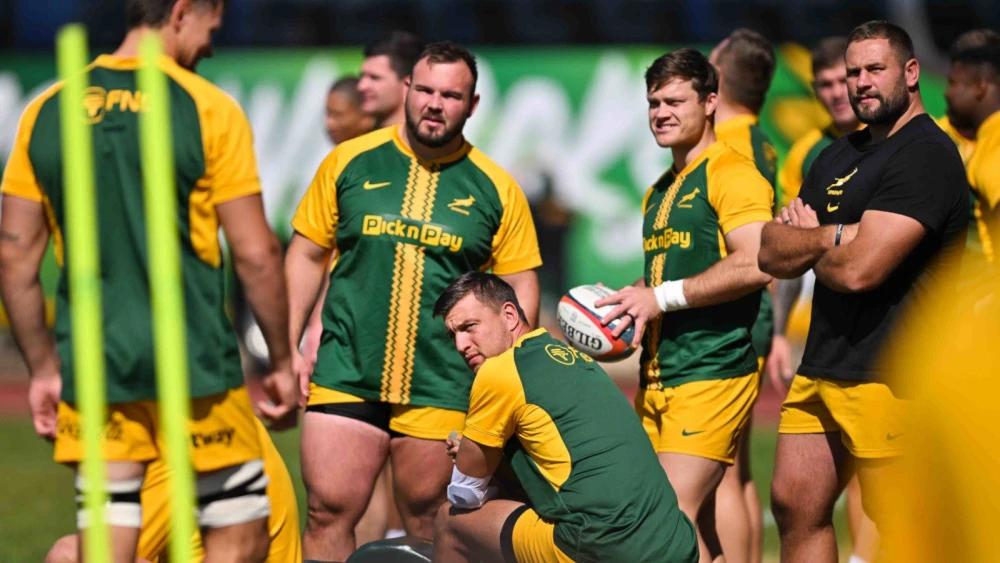
In the wake of Saturday's 33-16 upset in Johannesburg, much of the focus has been on singling out a few players, but that might not be where the heart of the issue lies.
A formula that has delivered
Under Rassie Erasmus, the Springboks have embraced a game plan that plays to their set-piece and forward strength, as well as their deadly kick-chase game. Together, it allows them to wear down their opponents, win penalties and march up the field, and create try-scoring opportunities from broken play.
It's brought them a great deal of success as the cumulative effect of these tactics often simply overpower teams who can not withstand the onslaught. Coupled with a brutally effective bench, and it's often lights out for most challengers.
But if a team is able to hold its own in the scrums, as the All Blacks eventually did on Saturday, and the 50-50 contestables simply aren't going your way, the Boks can quickly start looking short of ideas.
When your traditional strengths fail you, you still need a solid set of core skills based on those age-old tactics of running and passing the ball to create the space needed for your players to get over the line.
This is where the Springboks still have work to do, and where they have arguably gone backwards in 2026.
In some ways, it is understandable. If your traditional strengths are constantly creating relatively easy try-scoring opportunities, why bother with all the hard work of setting up running lines, support play, clever passes and deception?
Those things are difficult to execute, after all, and can sometimes be defended far more easily than an up-and-under coming crashing down from 30 metres in the air, or a formidable scrum powering forward.
But at Ellis Park, the limitations of that mindset were exposed.
Where the Boks fell short
There's no sugar-coating the fact that the Springboks – despite playing under the same coach for eight years and having largely been together as a team for all that time – looked strangely disorganised at times when trying to play with ball in hand.
Sloppy back passes heading into no man's land; poor handling; players running up individually with no clear ideas, teamwork or support play in place – they were all on display on Saturday.
The problem was so glaring that even when they were camped in the All Blacks' 22 or inside their five-metre line, they didn't seem to have the confidence, calmness or composure needed to find a way over – to say nothing of a pre-designed tactical move that the players had memorised and were ready to employ.
For all their success in recent years, they have not grown much as an attacking side in that time, and may even be regressing after showing decent signs of improvement in this regard in 2024 and 2025.
Meanwhile, when the All Blacks found themselves in similar situations, they were able to trust in their handling and support play to get the job done, and seemed to have a few set moves up their sleeve to assist them.
It's not about the players
This is also why it doesn't feel quite on target to blame individual players for Saturday's defeat.
The Springbok halfbacks came under a lot of fire after their performances and, to be fair, Grant Williams' lack of urgency and indecision at ruck time was a definite problem. He looked far better when he was moved to the outside, where he could use his speed and running ability to its full effect.
Sacha Feinberg-Mngomezulu, meanwhile, also failed to stamp his mark on the game and wasn't able to get his backline moving.
But the reality is that the Springboks may not be getting the best out of these players, or fully exploiting the skills they have to offer. After all, playing a lot of rugby is something the Boks tend to do only when things aren't going their way, like in the second half on Saturday as the game was slipping away from them.
In the first half, the attempts to be more enterprising were certainly there, but they seemed erratic and unconvincing. None of the players looked particularly confident doing it, and their execution was poor, perhaps because they have had so little experience of playing that way this season.
Again, no one can deny Rassie's incredible success since taking as head coach, but bringing in attack coach Tony Brown was meant to address some of these shortcomings. Yet, outside of one or two memorable performances here and there, the Boks still aren't showing the kind of skill and consistency they need in this aspect of their game.
What makes it all the more frustrating is that South Africa is blessed with so much rugby talent that there really is no reason for this to be the case. We have the players capable of making the Springboks a far more well-rounded team in possession.
The next step for the Boks
The answer, then, isn't to throw generational players under the bus. But it's also not to suddenly rip up everything that has made the Springboks so successful.
Their set-piece, physicality and kicking game remain massive weapons, and abandoning those strengths would be unwise.
But the best teams are capable of winning in different ways.
That means developing the skills and attacking cohesion required to break down a defence when the usual avenues aren't available.
It means tapping into some of the other strengths our players possess, giving them clearer ideas, better support and more confidence with ball in hand, rather than simply hoping the next high ball, scrum or bit of individual brilliance will create the opening.
South Africa has more than enough talent to do it.
It's very possible the Boks traditional gameplan will come up trumps again in Cape Town this weekend, as it has so many times before, but if they want to remain ahead of the chasing pack, they need to add a few more tools to the toolbox.